



What Is a Fake Airdrop and Why Can a “Free” Token Be a Trap
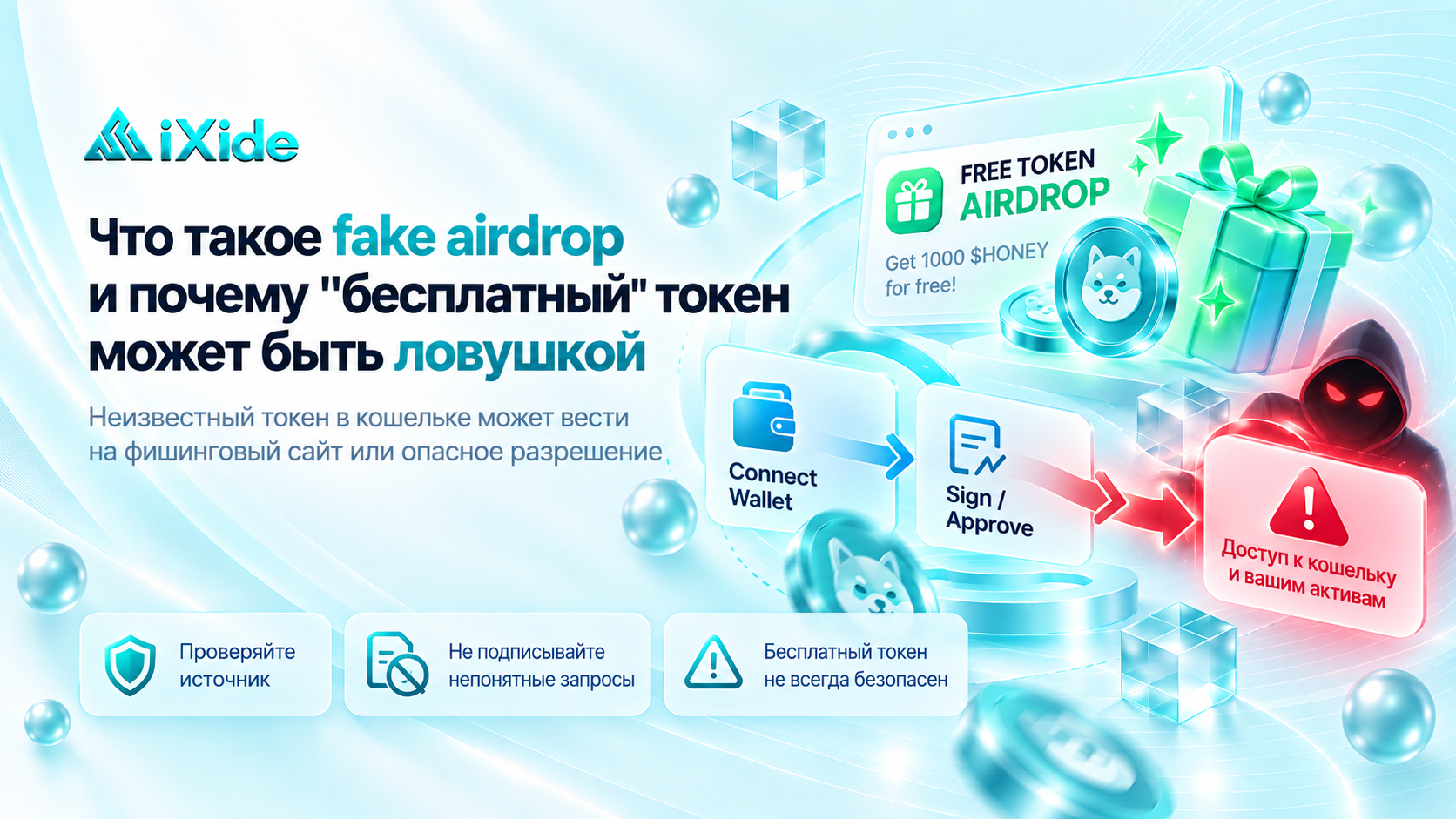
Sometimes a user opens a crypto wallet and suddenly sees a new token they never bought.
For example:
5,000 FREE
10,000 BONUS
Claim 2,500 USDT
AIRDROP — $3,000
Sometimes the wallet may even display an impressive value for that asset.
The first reaction is understandable:
“Did I really receive free cryptocurrency?”
Sometimes projects do run legitimate airdrop campaigns. But an unknown token that suddenly appears in your wallet can also be part of a scam known as a fake airdrop.
Let’s look at how it works and why the “gift” may actually be just bait.
What Is an Airdrop?
An airdrop is the free distribution of tokens to users.
Projects may use airdrops to:
attract new users;
reward early participants;
distribute governance tokens;
run marketing campaigns;
reward activity within an ecosystem.
For example, a user may have interacted with a protocol in the past, and later the project distributes tokens to eligible addresses.
Such an airdrop can be completely legitimate.
What Is a Fake Airdrop?
A fake airdrop is a fraudulent giveaway where the real goal is not to give the user an asset, but to make them perform a dangerous action.
The scheme may start innocently:
“Congratulations! You received 5,000 tokens.”
Then the user may be asked to:
Claim Reward
Unlock Tokens
Visit Website
Connect Wallet
This is usually where the real risk begins.
How Can an Unknown Token Appear in Your Wallet?
A blockchain address is public.
If an attacker knows your address, they can send certain tokens to it without your permission.
They do not need:
your password;
seed phrase;
private key;
access to your device.
So the simple fact that an unknown token appears in your wallet does not mean your wallet has been hacked.
The danger usually begins when the user interacts with the token or with a website connected to it.
How a Typical Fake Airdrop Works
Imagine that a token suddenly appears in your wallet:
10,000 USDT BONUS
The wallet may even show:
Value: $10,000
The user wants to understand where the money came from.
The token name or description may contain a link such as:
claim-usdt-example...
The website then says:
“Connect your wallet to claim your reward.”
The user connects the wallet.
After that, the site may ask them to:
Sign
or:
Approve USDT
or confirm another blockchain operation.
If the user signs a malicious permission, the attacker may gain the ability to interact with the user’s real tokens.
Why Do Scammers Send Tokens for Free?
Because sending cheap or nearly worthless tokens can be an effective form of advertising.
An attacker can distribute them to thousands of addresses.
Even if only a small percentage of users fall for the trap, the scheme may still be profitable.
It is essentially a message placed directly inside the wallet:
“You have money waiting — click here to claim it.”
Can the Token Itself Steal Your Cryptocurrency?
Simply receiving an unknown token usually does not give its creator access to your BTC, ETH, USDT, or other assets.
So if a strange token appears in your wallet, there is no need to panic.
The risk increases when the user:
visits an unknown website;
connects the wallet;
signs an unclear request;
grants Token Approval;
confirms a Permit;
gives other permissions to a smart contract.
So it is important to distinguish between:
a token appearing in your wallet
and
you granting a service permission.
These are completely different events.
Why Can a Fake Airdrop Show a Huge Value?
Suppose someone sends you:
100,000 AIRDROP
and your wallet suddenly shows:
≈ $25,000
That does not mean the token actually has a liquid market worth that amount.
The displayed price may be:
calculated from a manipulated trading pair;
taken from an incorrect data source;
based on a tiny liquidity pool;
incorrectly identified by the wallet interface.
So the dollar value shown on screen is not proof that the token has real value.
“Pay $50 to Receive $5,000”
This is another common scam.
The user is told:
“To activate the airdrop, pay a small fee.”
For example:
Receive $5,000
but first:
Send 0.02 ETH for activation.
After the payment, nothing happens.
Then the victim may be asked to pay again for:
tax
unlock fee
verification fee
gas deposit
If an unknown airdrop asks you to send money to someone else before receiving the “reward,” that is a serious warning sign.
Fake Airdrops Through Token Approval
A more dangerous version is related to Token Approval.
The user connects their wallet and believes they are confirming receipt of a free token.
But the transaction may actually grant an unknown spender permission to use the user’s real USDT or another token.
For example:
Your balance: 8,000 USDT
The website asks you to sign:
Approve USDT — Unlimited
If the user confirms it, this is no longer about receiving a free airdrop.
They are giving the contract real permission to access their tokens.
What About the Sign Button?
The word Sign does not automatically mean:
“This is safe because no money is being sent.”
Some signatures are indeed used only for login or authentication.
But other signatures can be connected to permissions or later actions involving assets.
So you should always check what exactly you are signing, not just the label on the button.
Fake Websites of Real Projects
A fake airdrop does not always promote an imaginary token.
Scammers may copy a well-known project using:
the official-looking logo
a similar design
an almost identical domain name
real token names
The website address may differ from the official one by just one character.
So a familiar brand on the page does not prove that the website is legitimate.
A QR Code Is Not Proof Either
Scammers may also distribute:
a QR code to claim the airdrop
After scanning it, the user is taken to a phishing website.
A QR code does not prove legitimacy — it is simply a convenient way to encode a link or other information.
Even a Real Airdrop Should Be Verified
Even if you have heard that a well-known project is genuinely running an airdrop, do not follow the first link you find.
Check:
the official project website;
official announcements;
the exact domain;
eligibility conditions;
the correct network;
the official token contract address.
Scammers often become especially active during real high-profile airdrop campaigns.
What Should You Do If an Unknown Token Appears?
The safest approach is to avoid interacting with it until you know where it came from.
Do not immediately:
try to sell it;
follow links in the token name;
connect your wallet to the suggested website;
sign transactions;
grant Approval;
send money for “activation.”
Some wallets allow you to simply hide unwanted tokens from the interface.
Should You Send the Token Back?
Usually, there is no reason to transfer it anywhere just to remove it from your wallet.
Any additional transaction creates unnecessary interaction and may cost a network fee.
If the token is simply spam, it can usually be ignored or hidden.
What If You Already Connected Your Wallet?
Connecting a wallet to a website does not automatically mean your funds are lost.
If you only connected and did not sign anything, that is different from granting Approval or confirming a transaction.
You should:
disconnect the website from your wallet;
review your transaction history;
check active Token Approvals;
make sure no unknown permissions remain.
If you signed something, you need to understand exactly what that request authorized.
What If You Granted a Suspicious Approval?
If an unknown contract received allowance for your tokens, you should review the permission and, if necessary, perform a Revoke.
Pay particular attention to:
USDT;
USDC;
other valuable tokens;
Unlimited Approvals.
Remember: Revoke can stop further use of the permission, but it cannot recover funds that may already have been transferred.
When Does the Situation Become More Serious?
If the user has shared:
a seed phrase;
a private key;
then the problem is much more serious than a single Approval.
Anyone with the private key may gain full control over the corresponding wallet.
A seed phrase should never be entered on an airdrop website, no matter how legitimate the project appears.
What Does This Mean for IXIDE Users?
If an unknown token suddenly appears in your wallet, there is no need to go through any “activation” on a third-party website in order to use IXIDE.
When making an exchange, rely on:
the asset shown in the active order;
the correct network;
the official token;
the address;
the amount;
Memo or Tag, if required.
If someone claiming to represent IXIDE offers “free tokens” through an unknown website and asks for your seed phrase, private key, or third-party Token Approval, do not confirm those actions.
IXIDE Recommends
If you receive an unexpected free token, do not start with:
“How do I claim it?”
Start with:
“Why did this token appear on my address?”
Check:
project → official source → contract → network → what action the website is asking you to sign.
Only then decide what to do.
Key Takeaway
A fake airdrop uses the promise of something free as bait.
A typical scheme looks like this:
unknown token → large value shown on screen → link → Connect Wallet → Sign / Approve → risk to real assets.
At the same time, simply receiving an unknown token does not mean your wallet has been hacked.
The main rule is:
receiving a token and giving access to your wallet are not the same thing.
If you unexpectedly receive “free crypto” and claiming it requires a seed phrase, payment, or an unclear permission, stop and verify what you are dealing with first.