



What Is a Honeypot Token and Why Can You Buy It but Not Sell It
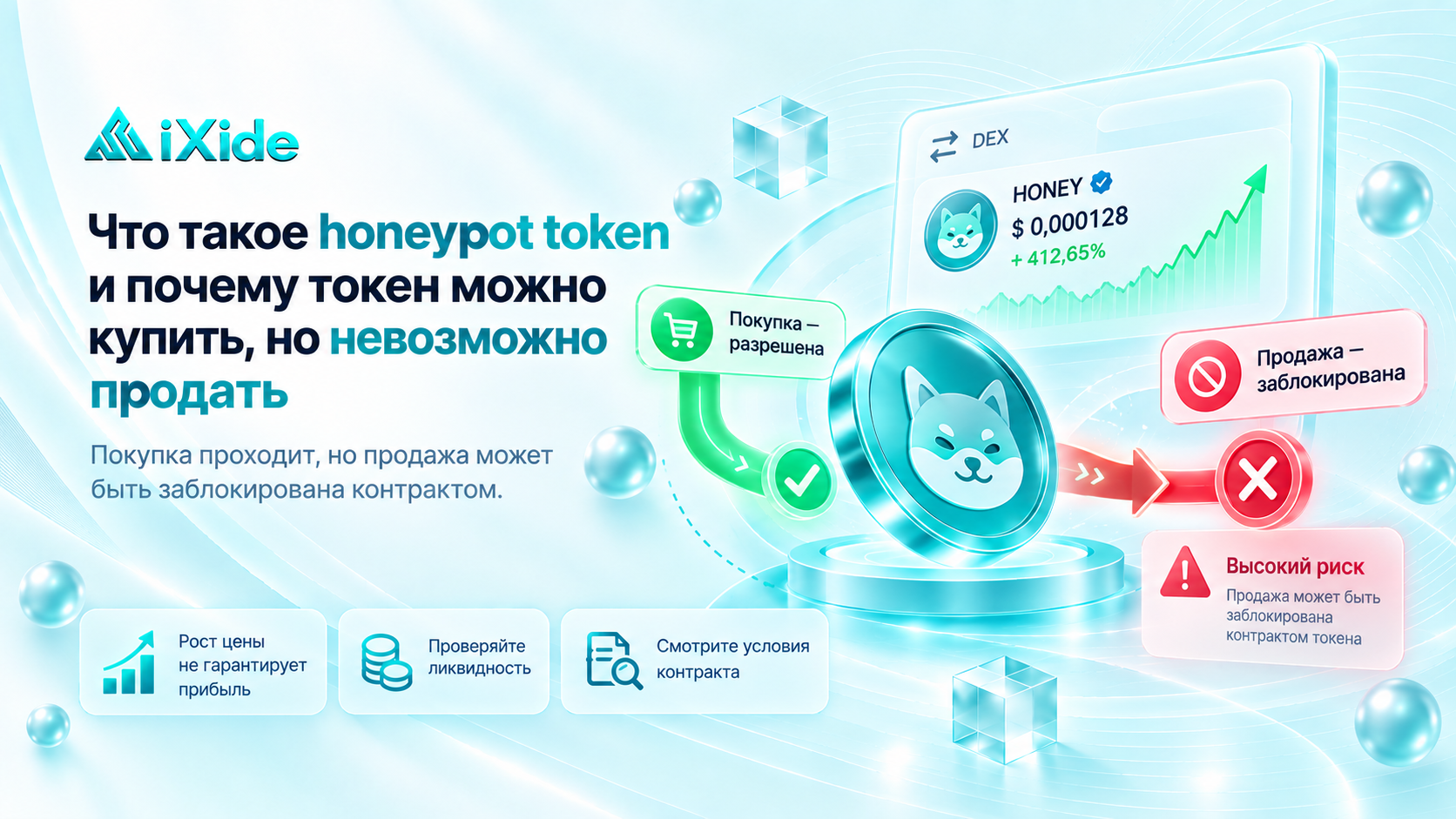
Sometimes a user discovers a new token, buys it through a DEX, and then sees the balance grow together with the token’s price.
For example:
Purchase: $100
A few hours later, the wallet shows: $800
But when the user tries to sell the token back into USDT, ETH, or another asset, the transaction keeps failing.
One possible reason is a honeypot token.
This is a token designed so that buying is possible, while selling is impossible or extremely difficult.
What Is a Honeypot Token?
The word honeypot literally means a “pot of honey.”
The idea is simple: users are attracted by an appealing chart, rapid price growth, or promises of high returns.
The purchase works.
But the smart contract may contain rules that restrict selling.
In simplified form:
USDT → token — allowed
token → USDT — blocked
As a result, money can enter the token, but an ordinary user may not be able to exit.
How Is This Even Possible?
Tokens on networks such as Ethereum or BNB Chain operate through smart contracts.
The contract defines the rules:
who can transfer tokens;
which operations are allowed;
what fees apply;
whether restrictions exist;
what permissions the contract owner has.
A malicious developer can add conditions that appear normal during a purchase but block the sale.
The blockchain itself is still working correctly — it is simply executing the contract code.
The Simplest Honeypot Example
Imagine a token called ABC.
A user buys:
100 USDT → 10,000 ABC
The purchase succeeds.
But when the user tries:
10,000 ABC → USDT
the contract checks the user’s address and rejects the transaction.
At the same time, the developer’s address may still be able to sell normally.
So the result is:
everyone can buy
only selected addresses can sell
Why Can the Price Keep Going Up?
If many users are buying a token but almost nobody is able to sell it, the chart can look extremely attractive.
For example:
$0.01 → $0.03 → $0.10 → $0.50
From the outside, it looks like demand is very strong.
But in reality, there may be almost no normal selling activity.
This creates the illusion of continuous growth.
A user may see a large portfolio value in the wallet even though converting those tokens back into a liquid asset may be impossible.
A $10,000 Wallet Balance Does Not Mean You Can Withdraw $10,000
This is an important point.
A wallet may show:
Token ABC: $10,000
But that number is usually calculated using the current displayed market price.
It does not guarantee that the entire position can actually be sold at that price.
If selling is blocked by the contract or there is almost no liquidity in the pool, the displayed value may be little more than a number in the interface.
So:
value shown on screen ≠ guaranteed amount you can cash out.
How Can Selling Be Blocked?
A honeypot can be implemented in different ways.
For example, the contract may:
allow selling only from certain addresses;
blacklist ordinary buyers;
block transfers to a DEX address;
introduce restrictions after purchase;
charge an extremely high sell fee;
change trading rules after launch.
For the user, the outcome is the same: buying works, but exiting does not.
What Is a Blacklist?
Some tokens include a blacklist function.
This can also exist in legitimate projects for certain purposes, but in a malicious token it can be used against buyers.
For example:
A user buys the token.
Their address is then automatically or manually marked as:
Blocked
After that, sending or selling the token becomes impossible.
What If the Sell Tax Is 99%?
This is another similar setup.
Technically, selling may still be allowed.
But the contract could set:
Buy tax: 1%
Sell tax: 99%
The user sells tokens worth $1,000 and receives only a tiny fraction of that amount.
Strictly speaking, this may not be a classic honeypot with a full sell restriction, but for the user the result can be almost the same.
Why Can the Developer Still Sell?
The contract may contain special exceptions.
For example:
Owner → allowed
Whitelist → allowed
Regular user → blocked
That is why you may see some successful sell transactions and assume:
“So the token can definitely be sold.”
But those transactions may have come only from pre-approved addresses.
A few successful sales do not prove that every holder has the same ability.
What Is a Whitelist?
A whitelist is a list of addresses that receive special permissions.
In a honeypot scheme, it may include:
the token creator;
wallets linked to the creator;
addresses used to create the appearance of normal trading.
Everyone else may be subject to different rules.
Why Doesn’t an Automated Token Check Give a 100% Guarantee?
There are services that analyze smart contracts and try to detect honeypots.
They may check:
whether buying works;
whether selling works;
transaction taxes;
owner permissions;
suspicious contract functions.
This can be useful as an additional tool.
But it should not be treated as a guarantee.
A contract may:
change settings later;
use a proxy;
apply different rules to different addresses;
activate restrictions after a certain event.
So one green checkmark does not mean the token is completely safe.
How to Check a Token Before Buying
If the asset is relatively unknown, several things are worth checking.
Contract
Find the official contract address and inspect it through a blockchain explorer.
Look at:
whether the source code is published;
what functions are present;
what permissions the owner has;
whether fees can be changed;
whether blacklist or whitelist functions exist.
Trading History
Look not only at purchases, but also at real sell transactions.
It is important to see that the token is being sold successfully by multiple independent addresses, not just one or two related wallets.
Liquidity
Even if selling is technically allowed, the trading pool still needs enough liquidity.
Without sufficient liquidity, selling a large amount at the displayed price may be impossible.
Token Holders
If a very large percentage of the supply is concentrated in only a few wallets, that creates additional risk.
A large holder can strongly affect the market.
Can a Small Test Purchase Help?
Sometimes users make a small test before buying a larger amount:
buy a small amount → immediately try to sell part of it.
This can expose an obvious honeypot.
For example:
10 USDT → token → back to USDT
If the sale immediately fails, that is a serious warning sign.
But even a successful test is not a complete guarantee.
The developer may later change the rules or activate restrictions under different conditions.
What Is the Difference Between a Honeypot and a Rug Pull?
These terms are often confused.
Honeypot
A user can buy the token, but the contract restricts or blocks selling.
Rug Pull
The project creator may, for example, remove liquidity or dump a large amount of their own tokens.
As a result, the price collapses.
The mechanisms are different, although the outcome for holders can be similarly damaging.
Honeypot and Low Liquidity Are Not the Same Thing
Sometimes a token is difficult to sell not because the contract blocks the sale.
The reason may simply be a lack of buyers or liquidity.
For example:
the wallet shows a position worth $5,000, but the liquidity pool contains only $200.
Selling $5,000 worth of tokens at the displayed price is simply not realistic.
So it is important to distinguish between:
a sell restriction
and
a lack of usable liquidity.
Why Are New Tokens Especially Risky?
A well-known liquid asset usually has:
a long trading history;
many holders;
significant volume;
a well-known contract;
listings across multiple platforms.
A token created only a few hours ago may have none of these.
That makes it much harder to verify the contract rules and the developer’s intentions.
Be especially careful with claims such as:
“This new coin will do 100x today”
or
“Buy before the official listing.”
What If You Already Bought a Honeypot?
The first rule is: do not send more money in an attempt to “unlock” the sale.
Be especially cautious if a website asks you to:
pay an activation fee;
send more cryptocurrency;
connect to another unknown service;
enter your seed phrase;
grant an additional Unlimited Approval.
First, inspect the contract and determine why the sell transaction is failing.
If the contract itself blocks selling from your address, there may be no simple way to bypass that restriction.
What Should You Check in Your Wallet After Interacting With a Suspicious Token?
If you used an unknown DEX or website, also check:
which Token Approvals were granted;
whether any Unlimited Approval remains active;
which contracts received allowance;
whether there are any unfamiliar signed operations.
This is especially important if the site asked you to confirm several requests in a row.
What Does This Mean for IXIDE Users?
If an unknown token appears in your wallet with a high displayed value, that does not necessarily mean it is a liquid asset that can actually be exchanged.
Before taking action, check:
the exact token;
the network;
the contract address;
whether real selling is possible;
available liquidity.
When using IXIDE, rely on the specific assets and networks shown in the active order.
Having a token with a similar name or ticker in your wallet does not mean it is the same asset supported by the service.
IXIDE Recommends
Before buying an unfamiliar token, ask yourself:
Can it actually be sold?
Are different users successfully selling it?
Is there enough liquidity?
What permissions does the contract owner still have?
Can the contract change fees or block addresses?
And most importantly — do not judge a token only by a rising price chart.
Key Takeaway
A honeypot token is an asset that is easy to enter but impossible or extremely difficult to exit.
The purchase may work perfectly.
The displayed balance may grow.
The chart may show huge profits.
But the most important test happens when you try to sell.
So the simple rule for unknown tokens is:
it is not enough to check whether you can buy it — you also need to make sure you can actually sell it.