



Why the Same 0x Address Exists on Ethereum, BNB Chain, Base, and Other Networks
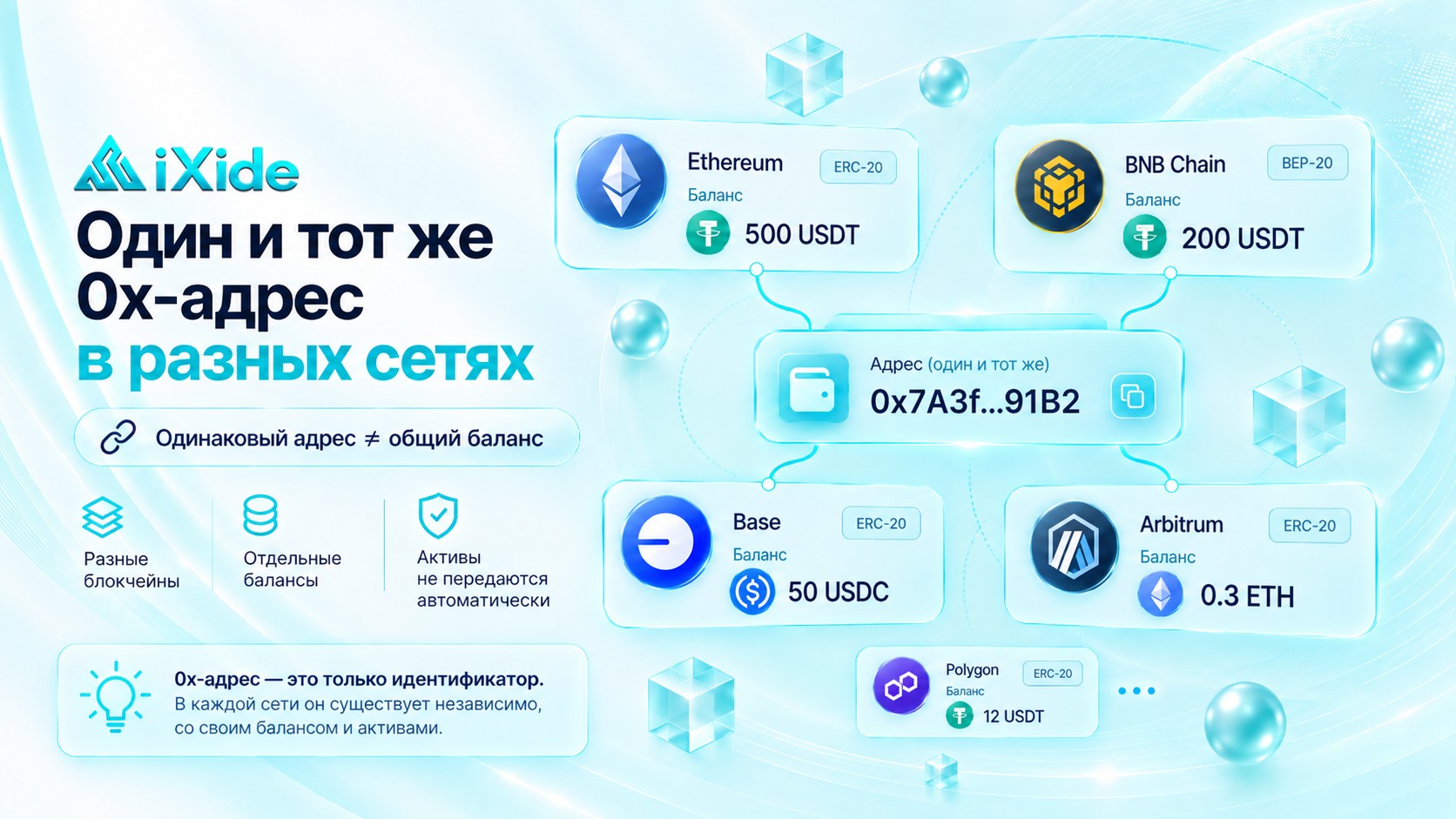
A beginner may find the following situation confusing: in a wallet, Ethereum is selected and the address looks like this:
0x7A3f...91B2
Then the user switches to BNB Chain, Base, Arbitrum, or Polygon — and the address remains exactly the same:
0x7A3f...91B2
This raises a logical question:
If the address is the same, does that mean the cryptocurrency in all these networks is stored in the same place?
No.
The same 0x address can exist across multiple EVM-compatible networks, but balances, tokens, and transactions on each network remain separate.
Let’s see why.
What Does a 0x Address Mean?
Addresses beginning with 0x are commonly used on networks compatible with the Ethereum Virtual Machine — EVM.
These include, for example:
Ethereum;
BNB Smart Chain;
Base;
Arbitrum;
Optimism;
Polygon;
Avalanche C-Chain;
other EVM-compatible networks.
These networks use similar account and cryptographic address systems.
That is why the same wallet can display the same address on several different networks.
Why Doesn’t the Address Change When You Switch Networks?
In a typical non-custodial wallet, the address is derived from the private key.
In simplified form:
private key → public key → 0x... address
If the wallet uses the same private key on Ethereum and BNB Chain, the resulting address will also be the same.
For example:
Ethereum:0x7A3f...91B2
BNB Chain:0x7A3f...91B2
Base:0x7A3f...91B2
The address is the same because the key is the same.
But the blockchains themselves are different.
The Most Important Point: Same Address ≠ Shared Balance
Imagine that the address:
0x7A3f...91B2
contains:
Ethereum: 500 USDT
BNB Chain: 200 USDT
Base: 50 USDC
The wallet does not merge these into one blockchain balance.
In reality, there are three independent states:
Ethereum → 500 USDT
BNB Chain → 200 USDT
Base → 50 USDC
Each network maintains its own transaction history and balances.
Why Doesn’t USDT on Ethereum Automatically Appear on BNB Chain?
Imagine a user receives:
1,000 USDT ERC-20
to their address.
Then they switch the wallet to BNB Chain.
The address remains the same.
But the 1,000 USDT does not appear there.
Why?
Because the transfer happened on Ethereum.
BNB Chain is a separate blockchain and does not copy Ethereum balances.
So:
the same address does not mean the same assets.
Think of It Like the Same Apartment Number in Different Cities
Imagine there is:
Central Street, Building 10, Apartment 25 in one city
and:
Central Street, Building 10, Apartment 25 in another city.
The apartment number is the same.
But these are two different places.
A 0x address works in a similar way across different blockchains.
The address may look identical, but the network determines where the funds actually exist.
What Happens When You Switch Networks in a Wallet?
When you select another network, the wallet does not necessarily create a new account.
Instead, it starts asking another blockchain:
“What assets exist on address 0x7A3f...91B2 on your network?”
Ethereum returns its own data.
BNB Chain returns its own.
Base returns its own.
That is why the balance can change completely when you switch networks even though the address itself stays the same.
Is the Private Key Really the Same?
For a standard EVM account in a non-custodial wallet — often, yes.
One private key can control the corresponding address across multiple compatible EVM networks.
That means if you fully control the wallet, you may use the same address on Ethereum, Base, BNB Chain, and other supported networks.
But there is an important exception.
Smart Contracts Can Be Different
A 0x... address may belong not only to a regular wallet but also to a smart contract.
And the same contract address on two different networks does not necessarily mean it is the same contract.
On Ethereum, that address may contain one piece of code.
On another network, it may contain:
a different contract;
a completely different project;
or nothing at all.
So two contracts should not be considered identical just because their addresses match.
Why Do You Still Need to Choose the Network?
This is exactly why exchanges and crypto services ask you to select a network.
For example, you enter:
0x7A3f...91B2
But the service still needs to know:
Ethereum?
BNB Chain?
Base?
Arbitrum?
An address alone is not enough.
What Happens If You Choose the Wrong Network?
Suppose you intended to receive USDT via Ethereum.
But the sender selected BNB Chain instead.
If the 0x address belongs to your own EVM wallet, the funds may still be accessible — but on BNB Chain, not on Ethereum.
So on Ethereum, you may see:
0 USDT
but after switching to BNB Chain, the tokens may appear.
This is one reason users sometimes think their cryptocurrency has “disappeared.”
In reality, it may simply be on a different network.
Can a Transfer Sent on the Wrong EVM Network Always Be Recovered?
No.
It depends on who controls the address.
If it is your own non-custodial wallet, recovery is often easier because the same private key may control the address on another EVM network.
But if the funds were sent to:
an exchange;
a crypto exchanger;
a custodial wallet;
a smart contract;
the situation becomes more complicated.
The service may simply not support the selected network.
Even if the blockchain transaction is successful, the funds may not be credited automatically.
Recovery will depend on the service itself.
Why Can an Exchange Show the Same Address for Several Networks?
Some services do use the same 0x deposit address across several EVM networks.
But this does not mean you can choose any network you want.
The platform still needs to monitor deposits on the exact blockchain you selected.
So even if the address is identical, always check which networks the service supports.
What Is Chain ID?
EVM networks are distinguished by a special identifier called a Chain ID.
The wallet needs to know not only:
0x7A3f...91B2
but also which network the transaction is being created on.
Chain ID helps keep transactions from one network separate from another.
That is why Ethereum and BNB Chain can use the same address format while remaining independent blockchains.
Why Are the Fees Different Too?
Because the networks are independent, transaction fees are paid according to the rules of the specific blockchain.
For example:
Ethereum → gas is usually paid in ETH
BNB Chain → gas is paid in BNB
Base → gas is paid in ETH on the Base network
So having ETH on Ethereum does not mean that balance is automatically available on another network.
The asset must exist on the exact network where the transaction is being made.
How Do You Move an Asset From One Network to Another?
A normal blockchain transfer does not change the token’s network.
For example, if you send USDT ERC-20 to another Ethereum address, it remains USDT on Ethereum.
To move an asset between different blockchains, users may use:
a blockchain bridge;
a centralized exchange;
a crypto exchange service;
other cross-chain mechanisms.
This is different from a normal address-to-address transfer.
Why Can a Wallet Show One Total Balance in Dollars?
Some wallets combine data from several networks and display:
Total Portfolio: $5,000
This can make it seem as though all assets are stored in one place.
But the total may actually include:
$2,000 on Ethereum
$1,500 on Base
$1,000 on BNB Chain
$500 on Arbitrum
The interface combines the values for convenience, but the blockchain balances remain separate.
How Can You Check Where the Funds Actually Are?
If you know the 0x address, you should check it in the explorer for the specific network.
For example, the same address can be checked separately in:
an Ethereum explorer;
a BNB Chain explorer;
a Base explorer;
an Arbitrum explorer.
Each one will show its own balance and transaction history.
So the correct question is not simply:
“Are there funds on this address?”
but:
“Are there funds on this address on this specific network?”
What Does This Mean for IXIDE Users?
When exchanging through IXIDE, the fact that the same 0x address can exist on multiple networks does not mean you should change the selected network yourself.
Follow the details shown in the active order:
cryptocurrency;
network;
address;
amount;
Memo or Tag, if required.
For example, if the order specifies a particular EVM network, the transfer should be made through that exact network even if the same address technically exists on others.
IXIDE Recommends
Before sending cryptocurrency, check two separate things:
Address:0x...
Network:
Ethereum / Base / BNB Chain / Arbitrum / another network.
A matching address does not mean the network also matches.
And if the asset does not appear after the transfer, first check which blockchain the transaction was actually sent through.
Key Takeaway
The same 0x address can indeed exist on multiple EVM networks.
But:
Ethereum ≠ BNB Chain ≠ Base ≠ Arbitrum.
Each network has its own:
balances;
transactions;
tokens;
fees;
block history.
The simplest rule for beginners is:
Address + network = where your assets actually exist.
A 0x address alone is not enough to know where the cryptocurrency is stored.