



What Are Coins and Tokens — What’s the Difference Between BTC, ETH, and USDT?
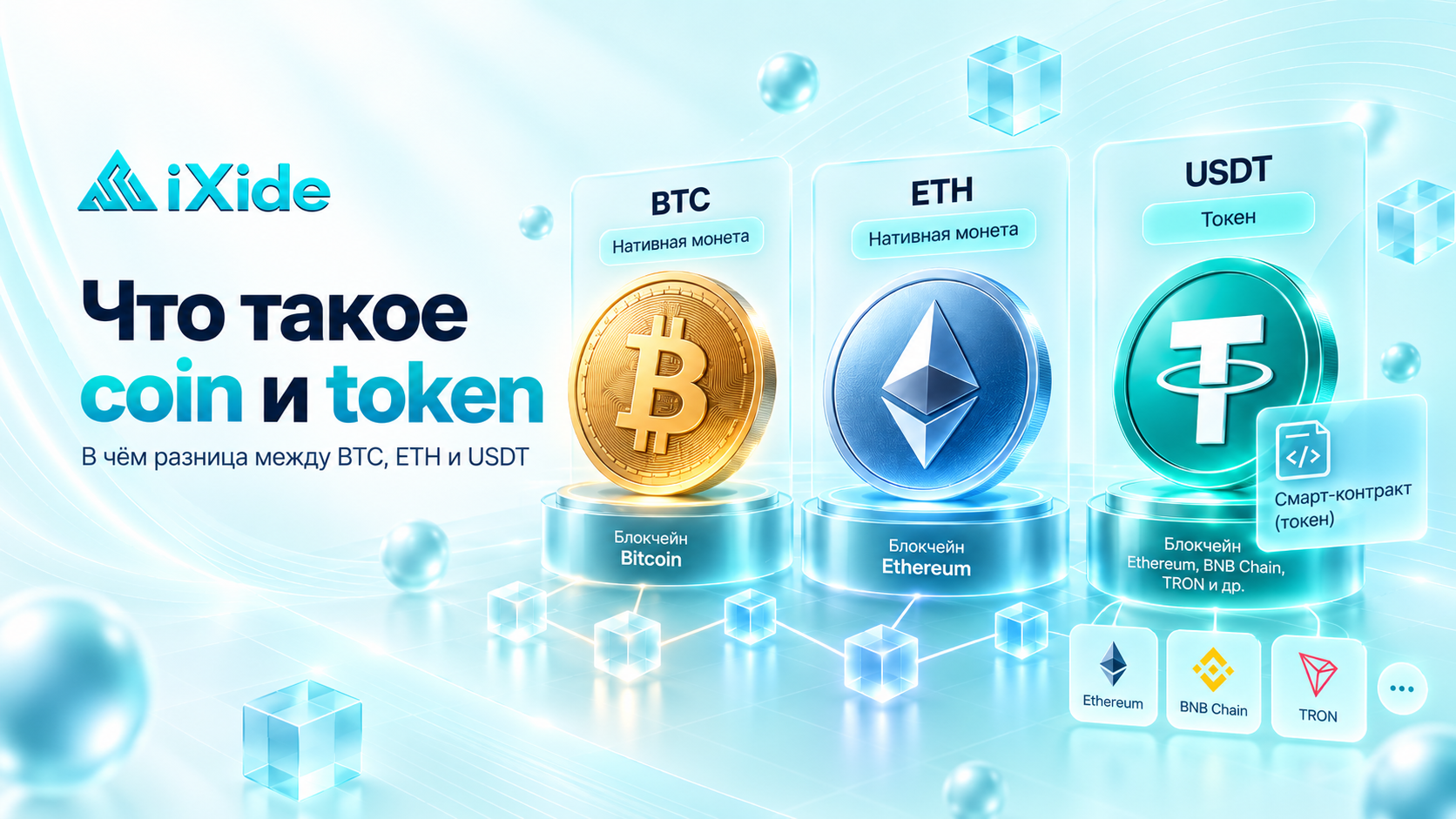
In cryptocurrency, the words coin and token are often used as if they mean the same thing.
For beginners, the difference may not be obvious: BTC, ETH, and USDT can all be stored in wallets, sent to other addresses, and exchanged.
But technically, they are different types of digital assets.
The easiest way to remember it is:
A coin is the native asset of its own blockchain.
A token is an asset that operates on an existing blockchain.
Let’s look at some examples.
What Is a Coin?
A coin is the native asset of a blockchain.
It is part of the network itself and is used for the network’s operation.
Examples:
BTC — the native coin of Bitcoin;
ETH — the native coin of Ethereum;
TRX — the native coin of TRON;
SOL — the native coin of Solana;
BNB — the native coin of BNB Smart Chain.
These coins exist directly at the blockchain level.
What Is a Native Coin Used For?
A native coin is usually used for more than just storing or transferring value.
It may also be required for:
paying network fees;
rewarding miners or validators;
interacting with smart contracts;
staking;
participating in the network’s consensus mechanism.
For example, on Ethereum, transaction fees are paid in ETH.
Even if a user sends USDT, the Ethereum network still requires ETH to pay for gas.
What Is a Token?
A token is a digital asset created on top of an existing blockchain.
It does not have its own independent blockchain.
Instead, it uses the infrastructure of another network.
For example, USDT can exist on:
Ethereum;
TRON;
BNB Smart Chain;
other supported networks.
USDT itself is not a separate blockchain.
A Simple Example
You can think of a blockchain as a country.
A coin is like the national currency of that country.
A token is like a digital asset or certificate that exists within that system.
For example:
Ethereum → ETH is a coin
And inside Ethereum, there can be:
USDT, USDC, and thousands of other tokens.
Is BTC a Coin or a Token?
BTC is a coin.
Bitcoin has its own blockchain.
BTC is the native asset of that network.
Bitcoin does not depend on Ethereum, TRON, or any other blockchain to exist.
Is ETH a Coin or a Token?
ETH is a coin.
Ethereum is its own blockchain, and ETH is its native asset.
It is used for:
paying gas;
running smart contracts;
staking;
transfers.
Ethereum also supports a huge number of tokens.
Is USDT a Coin or a Token?
USDT is a token.
It does not have its own independent blockchain like Bitcoin or Ethereum.
Instead, it is issued on multiple networks.
For example:
USDT ERC-20 — a token on Ethereum.
USDT TRC-20 — a token on TRON.
USDT BEP-20 — a token on BNB Smart Chain.
The asset is still called USDT, but technically these are implementations on different blockchains.
Why Can USDT Exist on Multiple Networks?
A token can be issued on several blockchains.
This allows users to choose a network based on:
transaction fees;
speed;
wallet support;
exchange or service support.
But it is important to remember:
USDT on different networks does not exist in the same place.
If you receive USDT TRC-20, it exists on TRON.
It will not automatically appear as USDT ERC-20 on Ethereum.
Why Do You Sometimes Need a Coin to Send a Token?
This is one of the most common questions beginners ask.
Imagine a wallet has:
1,000 USDT ERC-20
but no ETH.
The user can see the 1,000 USDT balance but may not be able to send it.
The reason is simple:
USDT is a token.
Ethereum transaction fees are paid in ETH, which is the native coin of the network.
The same principle applies to other networks.
For example:
USDT on BNB Smart Chain → BNB is required for gas
On TRON, network resources are used, and if there are not enough resources, TRX may be consumed.
Can a Token Become a Coin?
Sometimes a project launches first as a token on another blockchain and later creates its own network.
After launching its own mainnet, the asset may migrate to that blockchain.
Its technical role can then change.
So whether an asset is considered a coin or token depends on how its network is structured.
What Are ERC-20, TRC-20, and BEP-20?
These are token standards used on different blockchains.
For example:
ERC-20 — a token standard on Ethereum.
TRC-20 — a token standard on TRON.
BEP-20 — a token standard on BNB Smart Chain.
These standards define how tokens operate within a particular blockchain.
The standard itself is not a cryptocurrency.
Why Does a Token Usually Have a Contract Address?
On many blockchains, tokens are created using smart contracts.
That means a specific token is identified by:
the network;
contract address;
symbol;
other parameters.
That is why two tokens can have the same name but still be completely different assets.
Does BTC Have a Contract Address?
No.
BTC is the native coin of Bitcoin.
It does not have a normal token contract address like an ERC-20 token.
The same applies to ETH as the native asset of Ethereum.
It is important not to confuse:
ETH — native coin
with:
WETH — token on Ethereum.
What Is WETH?
WETH is a good example of how coins and tokens can be related.
ETH is a coin.
WETH is a token that represents ETH in a format that is easier to use with smart contracts.
So even the same underlying asset can exist in different technical forms.
Is a Coin Always Better Than a Token?
No.
They are simply different technical models.
A coin is required for the operation of its own blockchain.
A token uses an existing blockchain’s infrastructure.
Each approach has its own advantages and limitations.
So the question is not which one is “better,” but how the specific asset is designed.
What Should You Check Before Sending?
Before sending cryptocurrency, do not look only at the asset name.
You should understand:
whether it is a coin or token;
which network it is on;
which token standard is used;
which asset pays the network fee;
whether the recipient supports the selected network.
For example, seeing:
USDT
is not enough.
You should know whether it is:
USDT TRC-20, ERC-20, or another version.
What Does This Mean for IXIDE Users?
When creating an order through IXIDE, use the cryptocurrency and network shown in the active order.
If you are sending a token, also make sure that:
the correct network is selected;
the wallet has enough of the native coin to pay the network fee;
the recipient address matches the required network;
Memo or Tag is included if required.
For example, having USDT in your wallet does not necessarily mean you can send it without ETH, TRX, BNB, or another native network asset.
IXIDE Recommends
Before making a transfer, ask yourself two simple questions:
What asset am I sending?
Which network is it on?
These two checks alone can help prevent many common mistakes.
Key Takeaway
The difference is easy to remember:
BTC — coin
It has its own Bitcoin blockchain.
ETH — coin
It is the native asset of Ethereum.
USDT — token
It operates on other blockchains.
The main rule is:
A coin belongs to its own network. A token uses another network.
That is why, when working with tokens, it is especially important to check the network and understand which native coin is required to pay the transaction fee.