
Why You Shouldn’t Rely Only on a Token’s Name
In a crypto wallet, a user may see a familiar name such as USDT, USDC, or ETH and assume it is exactly the asset they were looking for.
But the name and logo alone do not prove anything.
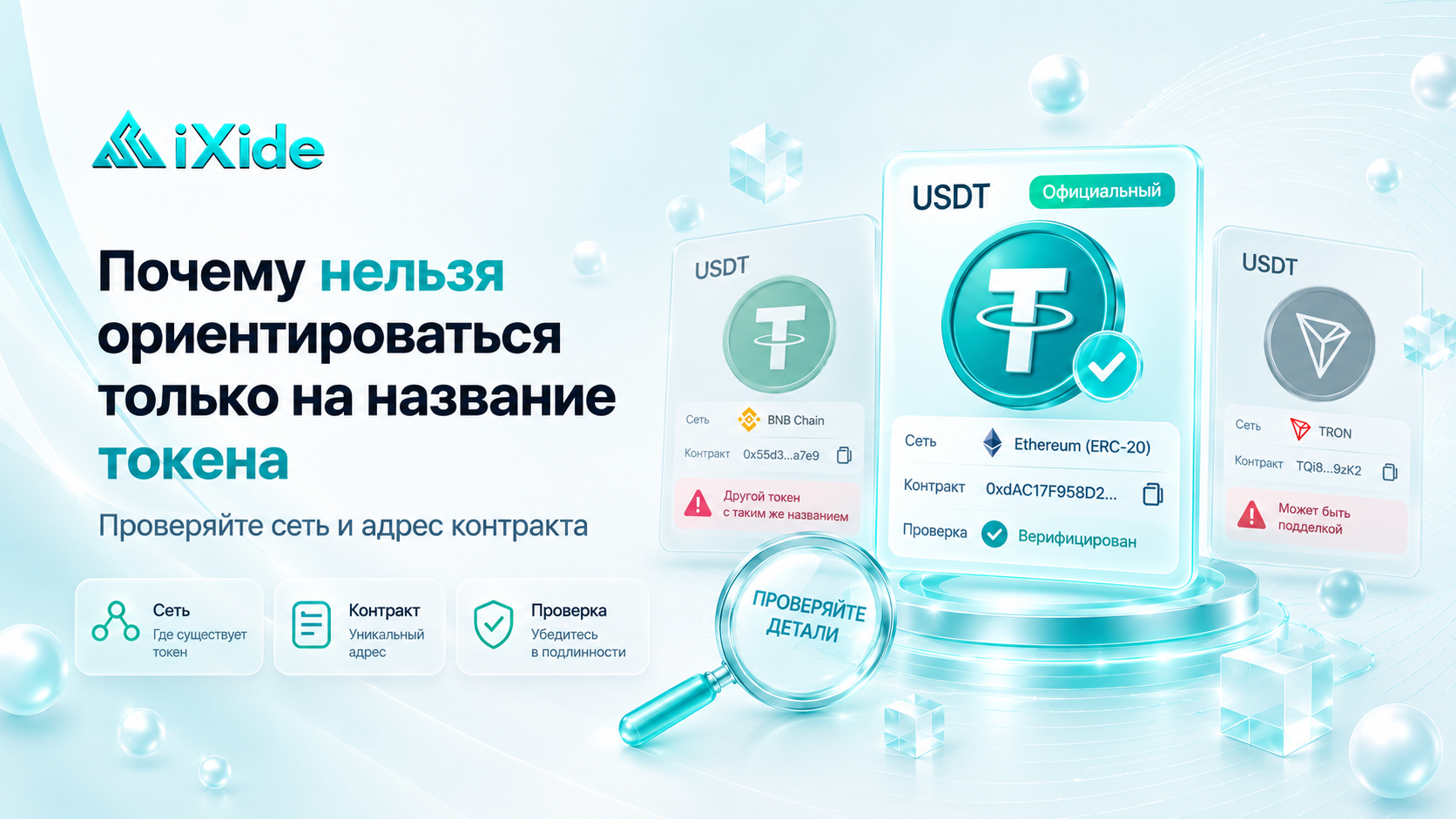
On the same blockchain, dozens of different tokens may exist with the same name and symbol. That is why, when receiving, sending, or exchanging cryptocurrency, it is important to check not only the label USDT, but also the network and the token’s technical identifier — for example, its smart contract address.
Let’s look at why this matters.
A Token Name Is Not Unique
On many blockchains, the creator of a token can define:
the name;
the symbol;
the total supply;
other token parameters.
For example, someone could create a new token and name it:
Tether USD
with the symbol:
USDT
In a wallet, it may look almost identical to the real USDT.
But technically, it would be a completely different asset.
Even the Logo Can Be Copied
A logo shown in a wallet is just part of the interface.
It is not cryptographic proof that the token is genuine.
A fake token may use:
the name of a well-known cryptocurrency;
the same ticker;
a similar logo;
a description that looks like the official project.
That is why relying only on appearance can be dangerous.
What Actually Identifies a Token?
For tokens issued through smart contracts, one of the most important identifiers is the contract address.
For example, on Ethereum, every ERC-20 token is associated with a specific smart contract.
In simplified form:
Name: USDT
Symbol: USDT
Network: Ethereum
Contract: specific address
It is the combination of the correct network and the correct contract address that tells you which token you are actually dealing with.
The contract address is unique within a particular network, so the blockchain itself must always be identified first.
Why the Network Matters Too
The same asset may exist on several blockchains.
For example, USDT is available on multiple networks.
However:
USDT on Ethereum and USDT on TRON are tokens on different blockchains with different technical identifiers.
So saying:
“I’m sending USDT”
is not enough.
You also need to know:
which USDT and on which network.
That is why exchanges and crypto services specify both the asset and the network.
How Fake Tokens Are Created
Creating a token on some blockchains is technically quite simple.
A scammer can:
create a new token;
call it USDT;
use the symbol USDT;
copy a similar logo;
send those tokens to other wallets.
The user opens the wallet and sees a familiar name.
But the token may have no connection to the real USDT and may have no actual value.
Why Unknown Tokens Sometimes Appear in Your Wallet
A public blockchain address is visible to everyone.
That means anyone can send certain tokens to it without asking the wallet owner for permission.
As a result, wallets may sometimes receive:
unknown tokens;
promotional assets;
fake airdrops;
tokens using names of popular projects;
spam tokens.
The fact that a token appears in your wallet does not mean it is genuine or valuable.
“My Wallet Shows $10,000” — But Is It Really Worth $10,000?
Sometimes a wallet may incorrectly estimate the value of an unknown token or display information that makes it appear valuable.
For example, an unknown asset may be called USDT and show a balance of:
10,000 USDT
The user may think they received $10,000.
But if the contract address does not match the genuine USDT contract, that balance may effectively be worthless.
The first step is always to determine what token is actually on the address.
How to Check Whether a Token Is Genuine
First, identify the network.
Then find the token through an official project source or a trusted blockchain explorer.
Compare:
the token name;
symbol;
network;
contract address;
token information in the explorer.
If the contract address is different, it is a different token — even if the name and logo look exactly the same.
What Can You See in a Blockchain Explorer?
If you open a token in a blockchain explorer, you can usually see:
contract address;
name;
symbol;
number of holders;
transfer history;
total supply;
other smart contract information.
This allows you to identify the asset far more accurately than by looking at its name in a wallet.
What Is a Verified Token?
Some blockchain explorers mark well-known projects as verified.
This may include:
confirmed token name;
official website;
logo;
project links;
additional contract information.
Such verification can be useful, but it is still better to compare the details with official sources from the project itself.
Not Every Asset Has a Token Contract
There is an important exception.
Native blockchain coins work differently.
For example:
BTC is the native coin of Bitcoin;
ETH is the native coin of Ethereum;
TRX is the native coin of TRON.
They do not have a standard ERC-20 or TRC-20 token contract address like regular tokens do.
So the verification method depends on whether you are dealing with a native coin or a token.
What About Solana and Other Networks?
Terminology may differ between blockchains.
For example, on Solana, tokens are identified using a mint address.
The principle remains the same:
the token name alone is not enough — you need the technical identifier of the asset on the correct network.
Why Is This Especially Important Before an Exchange?
Imagine that a user receives a token called USDT and then wants to exchange it.
But in reality, it is not official USDT — it is another token using the same name.
For an exchange service, these are completely different assets.
Simply seeing USDT in your wallet does not mean the service will be able to accept that token.
What Does This Mean for IXIDE Users?
When creating an order through IXIDE, rely on the asset and network shown in the current order.
Before sending funds, check:
cryptocurrency;
network;
recipient address;
Memo or Tag, if required;
the token itself, if you are unsure about its origin.
If your wallet shows several assets with the same name, do not choose one based only on the logo or ticker.
Check the network and the token identifier first.
Do Not Interact With Suspicious Tokens
If an unknown token suddenly appears in your wallet, do not immediately:
open links included in its name or description;
connect your wallet to an unknown website;
sign transactions;
grant Token Approval;
try to “unlock” or “claim” a reward.
Some tokens are specifically designed to lure users into phishing schemes.
A Simple Verification Rule
Before making a transaction, use this sequence:
Name → network → contract or other identifier → recipient address.
Not the other way around.
The token name helps you understand what asset you are looking for, but it does not prove that the token is genuine.
IXIDE Recommends
If you see a familiar token name, do not treat it as the only verification criterion.
Seeing USDT on the screen does not automatically mean you are looking at genuine USDT.
Be especially careful with new or unknown tokens that appear in your wallet without your involvement.
For tokens, the main reference points should be the correct network and the official technical identifier of the asset.
Key Takeaway
Two different tokens can have:
the same name;
the same symbol;
a similar logo.
And still be completely different assets.
Before sending or exchanging a token, always check:
network → token contract → recipient address.
In cryptocurrency, the name is only a label.
The real asset is identified by its technical data on the blockchain.