



What Is a Gas Fee and Why Does the Cost of a Crypto Transaction Keep Changing?
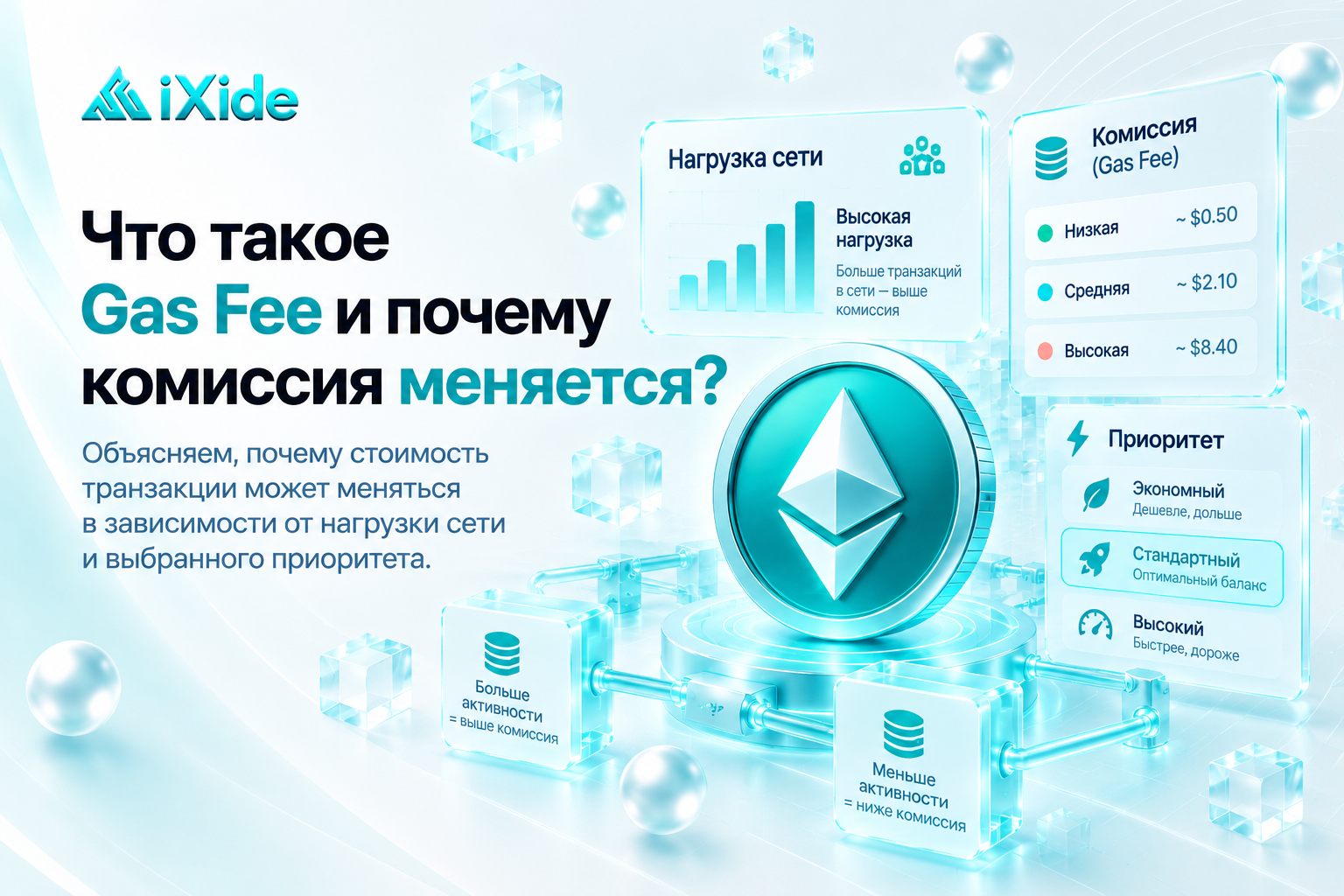
Welcome to IXIDE — your partner in the world of cryptocurrencies!
When sending cryptocurrency, users almost always encounter a network fee. Sometimes it is very small, while at other times it can suddenly become noticeably higher. This is especially common in networks where transaction costs depend directly on current network activity.
This fee is often called a Network Fee, and in some blockchains — particularly Ethereum — it is known as a Gas Fee. Let’s look at why this fee exists, who receives it, and why two similar transactions can cost different amounts.
What Is a Network Fee?
A blockchain is not a single centralized server. Transactions are processed by many participants in the network, such as miners or validators.
When a user sends cryptocurrency, the transaction must be verified, included in a block, and recorded on the blockchain.
The network fee is paid for using these resources.
It is important to understand that a network fee and an exchange service fee are not the same thing.
A Network Fee is directly related to the operation of a specific blockchain.
What Is Gas?
The term Gas is most commonly associated with Ethereum and Ethereum-compatible networks.
If we imagine a blockchain as a computer, Gas represents the amount of computational resources required to perform a specific action.
A simple transfer may require relatively few resources.
However, interacting with a smart contract, token, or DeFi protocol can be more complex and therefore more expensive.
Why Does the Fee Keep Changing?
One of the main reasons is network congestion.
When many users try to send transactions at the same time, demand for space in new blocks increases.
Users are effectively competing to have their transactions processed faster.
As a result, the recommended transaction fee may rise.
When network activity decreases, transaction costs usually fall as well.
Why Was the Transaction Cheaper Yesterday?
Imagine that the network was relatively quiet yesterday.
A user sent cryptocurrency and paid a small fee.
Today, market activity has increased sharply. Users are actively moving funds, interacting with exchanges, and using smart contracts.
As a result, demand for transaction processing becomes higher, and fees may increase.
The sender and recipient addresses can remain exactly the same, while the network fee changes significantly.
The Fee Does Not Always Depend on the Amount
A common misconception is that a larger transfer automatically means a higher fee.
In many blockchains, this is not how it works.
A transfer worth $100 and a transfer worth $10,000 may cost almost the same if the transaction structure is identical.
The fee is more often influenced by:
current network activity;
transaction type;
number of operations involved;
smart contract complexity;
selected transaction priority;
the rules of the specific blockchain.
Why Do Different Networks Have Different Fees?
Every blockchain works differently.
Bitcoin, Ethereum, TRON, Solana, and other networks use different mechanisms for processing transactions.
As a result, one network may offer very low transaction fees, while another may charge significantly more for a similar operation.
This is why, when sending the same asset such as USDT, it is important to check not only the token itself but also the selected network.
What Happens If the Fee Is Too Low?
In some networks, users can choose the transaction fee themselves.
If the fee is set too low during a period of high network activity, the transaction may remain unconfirmed for a long time.
The transaction has already been sent to the network, but operations with higher priority may be processed first.
This is one of the reasons why a crypto transaction can appear to be “stuck.”
Who Receives the Fee?
Depending on the blockchain, transaction fees may be distributed to miners or validators who help secure and operate the network.
In some networks, part of the fee may also be burned — permanently removed from circulation.
The exact mechanism depends on the rules of the blockchain.
Is It Possible to Send Crypto With No Fee at All?
Usually, no.
Even if a platform displays “0 fee,” the actual blockchain transaction still has a cost.
In this case, the platform may cover the network fee itself or include the cost in another part of the service.
The blockchain still has to process the transaction.
That is why it is important to distinguish between a fee-free transfer for the user and the actual cost of processing the transaction on the network.
How Can You Reduce the Fee?
If the transaction is not urgent, it may sometimes make sense to wait until network activity decreases.
You can also compare available networks if the asset supports several blockchain options.
However, you should never choose a network only because it is cheaper.
The sender’s network must match the network specified by the recipient or in the exchange order.
Choosing the wrong network can cost far more than the amount saved on transaction fees.
What Should You Check Before Sending?
Before confirming a transaction, make sure you have correctly entered:
cryptocurrency → network → address → amount → fee → MEMO/Tag, if required.
Once a blockchain transaction is confirmed, these details usually cannot be changed.
IXIDE Recommends
Do not evaluate a transaction only by its fee.
First, make sure the network and recipient address are correct.
If the fee seems unusually high, do not rush to confirm the transaction. Check the current network activity and transaction parameters first.
A few extra seconds of verification can help prevent a much more serious mistake.