



Why You Should Never Reuse Payment Details From an Old Exchange Order
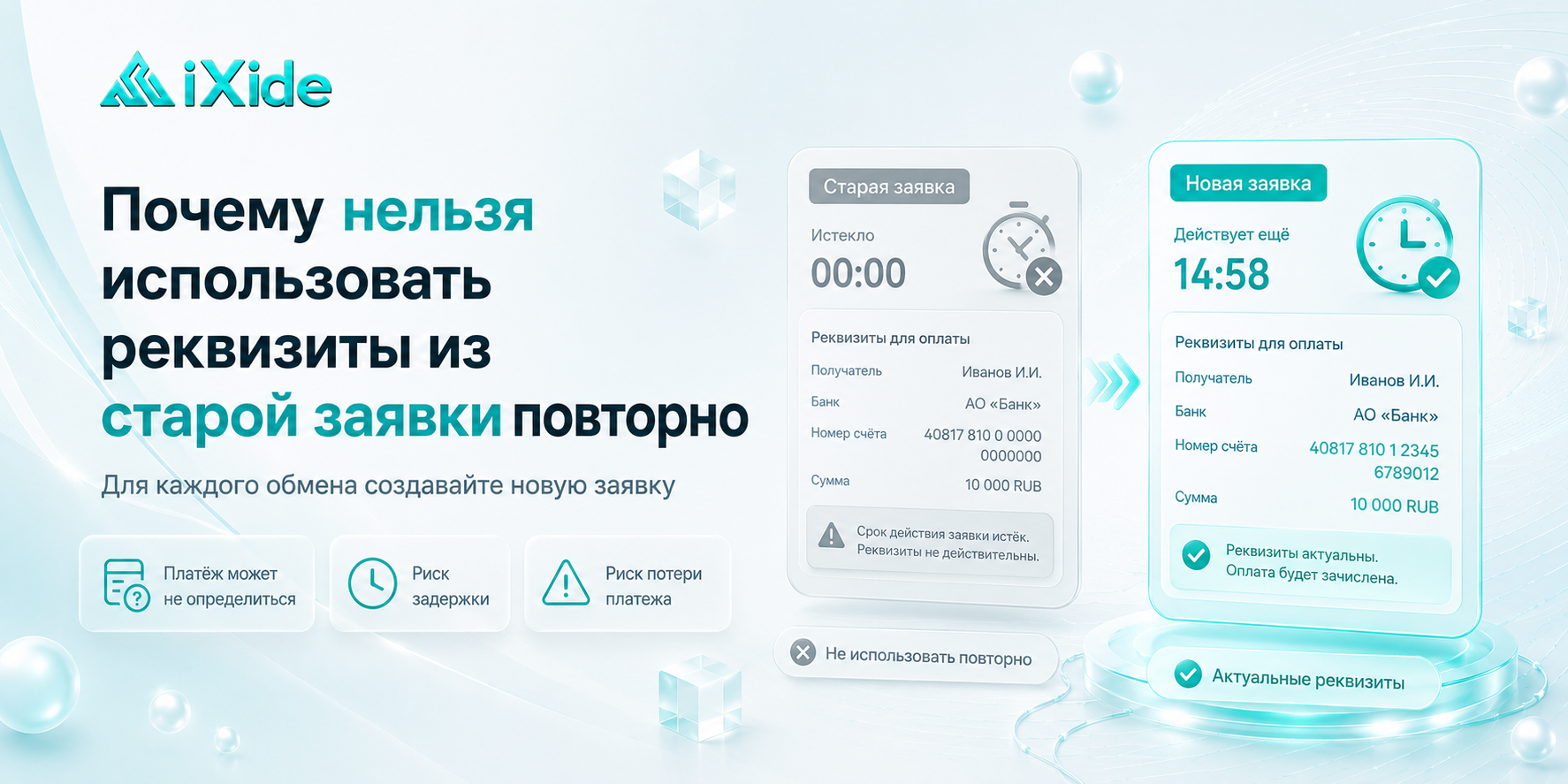
When exchanging cryptocurrency, users receive payment details inside a specific exchange order.
Sometimes it may seem convenient to save those details and use them again later — especially if the bank, amount and exchange direction appear to be the same.
However, this should not be done.
Payment details from an old order may no longer be valid. Sending money to them again can lead not only to delays and manual review, but also to a situation where the payment is not automatically found or correctly linked to a new order. In some cases, recovering or returning such a payment may be difficult, and there is a risk of losing funds when outdated payment details are used.
Let’s look at why every new exchange should start with a new order and why only the payment details shown in the current order should be used.
Payment Details Are Linked to a Specific Order
When a user creates an order, the system defines the conditions for that specific transaction.
The order may include:
exchange direction;
amount;
exchange rate;
payment deadline;
banking details;
cryptocurrency network;
wallet address;
transaction status;
other exchange parameters.
That is why payment details should not be treated separately from the order itself.
They are part of a specific transaction.
Why Payment Details Can Change
A crypto exchanger may use different payment details for different orders.
This can depend on:
the selected bank;
the transaction amount;
available limits;
current system load;
availability of the payment direction;
internal processing conditions.
Even if a user sent money to certain details yesterday, the system may provide different details today.
This is a normal part of exchange infrastructure.
An Old Order Is Already Closed
Once an order has been completed, cancelled or expired, it should no longer be used for new payments.
From the system’s point of view, that transaction has already reached its final status.
If another payment is later sent to the old payment details, it may not be automatically linked to any active order.
As a result, additional investigation may be required.
What Can Happen If You Pay Using Old Details Again?
If a user sends money using the payment details from a previous order, several problems may occur.
For example:
the system may not find an active order;
the payment may not be detected automatically;
the amount may not match the expected amount;
the payment details may already be used for other transactions;
manual review may be required;
processing may take longer;
the payment may remain unlinked to the correct order;
locating or returning the payment may become difficult;
in some situations, the funds may be lost.
That is why old payment details should never be reused.
Why You Should Not Create a New Order After Sending the Payment
Sometimes a user first sends money using saved payment details and only then creates a new order for the same amount.
This is also the wrong sequence.
The new order may have:
different payment details;
a different exchange rate;
a different payment deadline;
a different available reserve;
different conditions.
As a result, the payment sent in advance may not match the new order.
The correct sequence is always:
create a new order → receive the current payment details → verify them → make the payment.
The Exchange Rate Is Also Linked to the Order
Payment details are not the only thing that can change.
Cryptocurrency rates move constantly.
For example, yesterday an order may have shown:
100,000 RUB → 1,080 USDT
Today, the same amount may result in a different final amount.
If money is simply sent to old payment details, the conditions of the old order cannot automatically be applied to the new transaction.
Every new exchange must be created using the current rate.
Minimum and Maximum Limits Can Change
Exchange limits may also change.
For example, yesterday the direction may have allowed:
10,000 to 100,000 RUB
while today it may allow:
20,000 to 150,000 RUB
This may depend on current conditions, available reserves and exchange infrastructure.
Using old payment details does not take these changes into account.
The Payment Time for the Old Order May Have Expired
After an order is created, there is usually a limited period available for payment.
The timer helps keep the transaction conditions current.
After the payment period expires, the order may:
become expired;
be cancelled;
require recalculation;
stop accepting automatic payment processing.
So even if the payment details appear unchanged, they should not be used after the order has expired.
Why Payment Details May Be Temporary
For some exchange directions, banking details may only be active for a limited period.
This can be connected with:
transfer limits;
current workload;
payment distribution;
availability of a specific exchange direction.
Payment details that worked a few hours ago may therefore no longer be valid.
What If the New Order Shows the Same Details?
Sometimes the system may actually provide the same payment details again.
However, that still does not mean the user could have sent money without creating a new order.
The important point is not only the payment details themselves, but the fact that they were issued inside an active order.
A new order allows the system to understand:
who is making the exchange;
what amount is expected;
which rate applies;
which exchange direction was selected;
which status should be assigned to the transaction.
That is why payment should only be made after a current order has been created, even if the payment details happen to match an older order.
Why It Is Important to Send the Exact Amount
A new order also specifies the exact amount expected.
If a user sends the amount from an old order, it may not match the new one.
For example:
old order — 50,000 RUB
new order — 52,000 RUB
If the user sends 50,000 RUB from memory, the system receives an amount that does not match the active order.
This may lead to additional verification or recalculation.
What Should You Do If You Already Sent Money to Old Payment Details?
The most important thing is not to send a second payment immediately.
First, check:
the amount;
the date and time of the transfer;
the bank;
the recipient details;
the old order number.
Then contact the exchanger’s support team as soon as possible and explain what happened.
It is useful to prepare:
the old order number;
the payment amount;
the payment time;
proof of payment;
details of the new order, if one has already been created.
It is important to understand that when payment is sent to outdated details, automatic crediting is not guaranteed. Locating the payment may take additional time, and whether it can be returned depends on the specific situation.
Do Not Create Multiple Orders for One Payment
If the payment has already been sent, do not create several new orders hoping that one of them will automatically detect it.
This can make matching the payment even more difficult.
One payment should correspond to one specific order.
If a mistake has occurred, it is better to contact support immediately.
Why This Is Especially Important for Large Amounts
The larger the transaction, the more important it is to follow the details of the current order exactly.
For large exchanges, the following may differ:
limits;
banking details;
available reserves;
rate conditions;
processing procedures.
Using saved payment details for a large transfer is especially risky because an error can have serious financial consequences.
What About Cryptocurrency Addresses?
A similar rule should be followed for cryptocurrency addresses.
If an exchanger provides a wallet address for a specific order, it is safer to use exactly the address shown in the current transaction.
Do not automatically copy an address from an old transaction history.
Before every cryptocurrency transfer, check:
the wallet address;
the blockchain network;
the amount;
Memo or Tag, if required.
This reduces the risk of errors and possible loss of funds.
Why Creating a New Order Takes Seconds but Reduces Risk Significantly
Creating a new order usually takes far less time than resolving an incorrect payment.
The user immediately receives:
the current exchange rate;
current limits;
valid payment details;
the exact amount;
an active payment timer.
A few extra seconds can prevent a much longer manual investigation and reduce the risk of losing a payment.
How It Works in IXIDE
For every new exchange in IXIDE, users should create a separate order and use only the payment details displayed inside it.
Before making the payment, check:
the exchange direction;
the amount;
the bank;
the payment details;
the order validity period;
the final amount to be received.
Even if a user has completed a similar exchange before, payment details from a previous order should not be reused without a new active order.
If a payment has already been sent using old details, do not send the money again. Save the payment confirmation and contact IXIDE support as soon as possible.
Key Takeaway
Payment details provided by a crypto exchanger are not permanent details for all future payments.
They are issued as part of a specific order and are connected to its conditions.
Between two exchanges, the following may change:
the exchange rate;
the amount;
transaction limits;
available reserves;
banking details;
payment deadline;
conditions of the exchange direction.
If old payment details are used, the payment may not be detected automatically, may require manual investigation, and in some cases returning the funds may be difficult or impossible.
That is why every new exchange should follow one simple rule:
create a new order → receive the current payment details → verify them → only then make the payment.
This significantly reduces the risk of delays, incorrect crediting and possible loss of funds.