



Why Can the Same Exchange Amount Have Different Rates Across Banks?
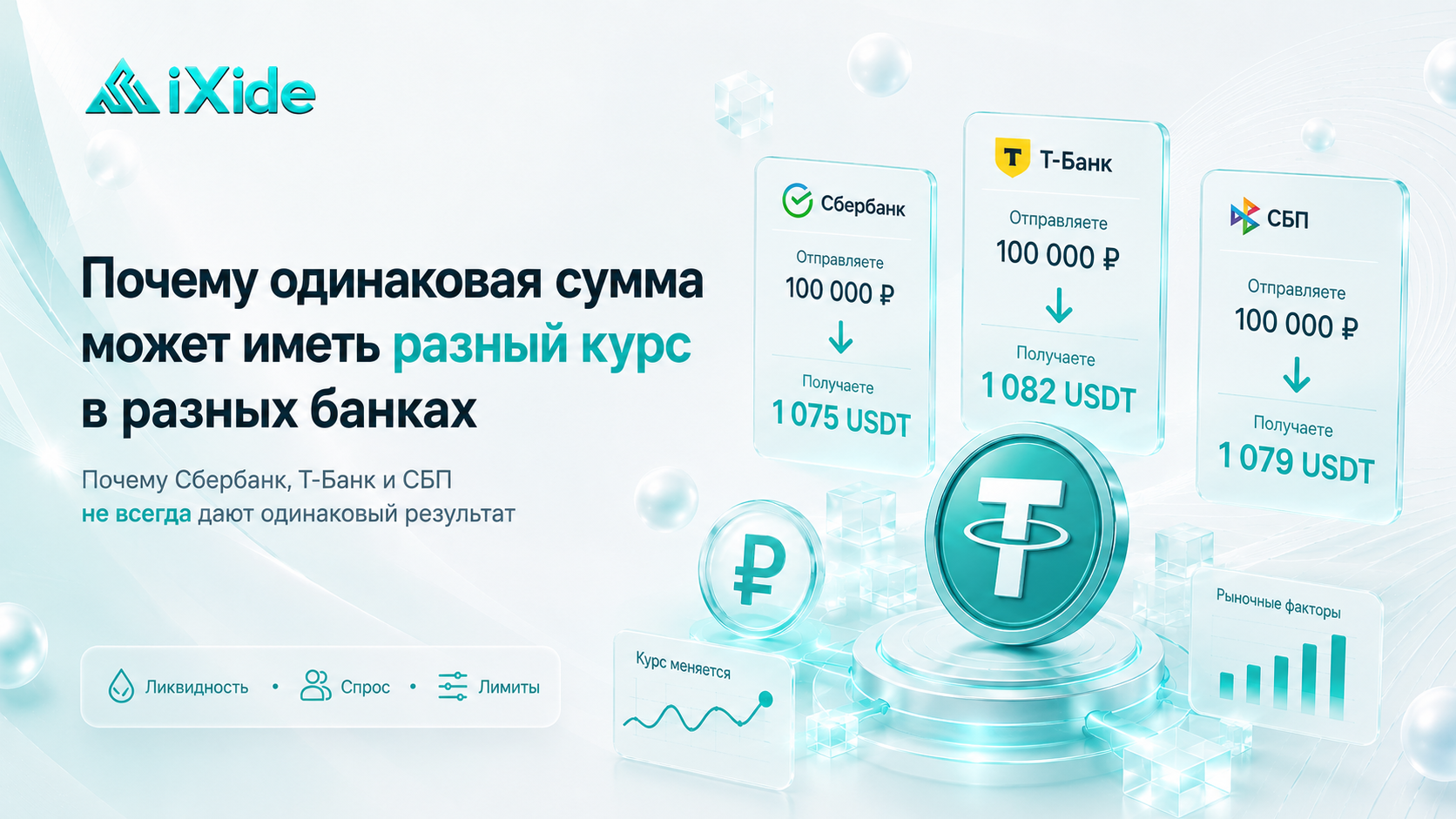
A user may choose the same amount, the same cryptocurrency and even the same blockchain network, but still see different exchange rates depending on the bank.
For example:
100,000 RUB → USDT TRC20 via Sberbank
and
100,000 RUB → USDT TRC20 via T-Bank
may be calculated differently.
At first glance, this may seem strange: the amount is the same and the cryptocurrency is the same, so the rate should also be identical.
In practice, however, the banking direction is a separate part of the exchange process. Each bank has its own conditions, liquidity, limits and availability of payment details.
Let’s look at why exchange rates may differ and what affects them.
The Bank Is Part of the Exchange Direction
When a user selects an exchange, the service takes into account more than just the currency and the amount.
For example:
Sberbank RUB → USDT TRC20
and
T-Bank RUB → USDT TRC20
are treated as different exchange directions by the system.
Although the user sends rubles and receives USDT in both cases, the banking part of the transaction is processed differently.
That is why each direction may have its own exchange rate.
Why Can’t One Rate Be Used for All Banks?
Different banks may have different:
transfer limits;
availability of payment details;
payment processing speeds;
available liquidity;
internal restrictions;
current load;
transaction costs.
All of these factors can influence the final exchange conditions.
At a particular moment, one bank may be more convenient for processing payments, while another may be less efficient.
This can be reflected in the exchange rate.
What Is Bank Liquidity?
In this context, liquidity means the ability to receive or send the required amount quickly through a particular bank.
Imagine that one bank currently has a large volume of available payment capacity.
Another bank may have much less available volume.
In that case, the first direction may offer better conditions.
The opposite can also happen.
Liquidity changes constantly, which is why exchange rates for different banks can also change throughout the day.
Why Doesn’t the Most Popular Bank Always Have the Best Rate?
It may seem logical that the most popular bank should always offer the best exchange rate.
But this is not necessarily true.
High popularity can also mean high demand.
If a large number of users want to exchange through the same bank at the same time, the load on that direction increases.
As a result, the conditions may temporarily become less favorable.
Another bank may have more available liquidity at the same moment and therefore offer a better rate.
Demand for a Specific Exchange Direction
The rate depends not only on the cryptocurrency market but also on user demand.
For example, at a certain moment most clients may choose:
Sberbank → USDT
Demand for this direction increases.
At the same time:
T-Bank → USDT
may be used less frequently.
If its available liquidity is higher relative to demand, the service may be able to offer a different rate.
So the same exchange amount does not necessarily mean the same market conditions.
Bank Limits Also Matter
Banks may have different restrictions on transfers.
For example:
maximum amount per transaction;
daily limits;
monthly limits;
limits on the number of transfers.
These restrictions can vary significantly between banks.
If a large order requires several payments or additional payment details, the operational cost of processing it may increase.
As a result, the exchange rate for that direction may differ slightly.
Why Can Rates Differ Even With the Faster Payments System?
The Faster Payments System is often perceived as a single payment method.
However, the transfer still passes through specific banks.
As a result, there may still be differences in:
available payment details;
transfer limits;
processing speed;
current load;
liquidity.
That is why even FPS-related banking directions may have different exchange rates.
How Payment Speed Affects the Rate
The speed of the banking part of the transaction can also matter.
If transfers through a particular bank are usually fast and stable, the service can process orders more predictably.
If a direction sometimes requires additional processing time, this creates extra exposure to market price changes.
During periods of high volatility, even several minutes can matter.
That is why payment processing characteristics may be taken into account when the rate is calculated.
Why Can the Rate for the Same Bank Change Between Morning and Evening?
Bank liquidity and demand are not constant.
In the morning, one bank may have a large amount of available payment capacity.
By the evening, the situation may change.
Factors include:
the number of active orders;
the volume of completed transactions;
available transfer limits;
available payment details;
user demand.
As a result, the exchange rate for a particular bank can change during the day even if the market price of USDT remains relatively stable.
Why Does a Large Amount Affect the Rate More?
Consider two orders:
10,000 RUB → USDT
and
1,000,000 RUB → USDT
For a smaller order, finding sufficient banking liquidity is usually easier.
For a large order, much more available capacity may be required.
If one bank has enough liquidity and another does not, the exchange conditions may differ.
That is why the difference between banking directions can be more noticeable for larger transactions.
Why Is RUB → USDT Different From USDT → RUB?
The direction of the exchange also matters.
For:
RUB → USDT
the exchanger receives rubles and sends cryptocurrency.
For:
USDT → RUB
the service receives cryptocurrency and arranges a payout in rubles.
These are two different processes.
That is why even for the same bank, the buying and selling rates for cryptocurrency will usually be different.
This is similar to a traditional currency exchange office, where the buying and selling rates for the US dollar are not identical.
What Is the Spread Between Exchange Directions?
The difference between buying and selling conditions is often called the spread.
It helps account for:
market movements;
liquidity;
operational costs;
rate fluctuations;
availability of banking directions.
The size of the spread may change depending on current conditions.
So one bank may offer better conditions for buying USDT today, while another may be better for selling it.
Does a Different Rate Mean One Bank Is Worse?
No.
A different rate does not mean that one bank is better or worse than another.
It simply reflects the current conditions for that specific exchange direction.
For example, Sberbank may offer a better rate today.
A few hours later, T-Bank may become more favorable.
The next day, the situation may change again.
That is why it is better to look at the actual final amount rather than the bank name itself.
Why Is It Better to Compare the Final Amount?
Suppose a user wants to exchange:
100,000 RUB
With one bank, they receive:
1,075 USDT
With another:
1,082 USDT
In this case, the actual difference is best understood by looking at the final amount received.
When choosing an exchange direction, it is useful to compare:
how many rubles you send;
how much USDT you receive;
which bank is used;
the exchange rate;
the limits;
the available reserve.
The final amount provides a clearer picture of the real exchange conditions than the rate alone.
Can the Rate Change After an Order Is Created?
This depends on the rate-fixing rules of the service.
If the exchanger fixes the rate when the order is created and the user completes the payment on time, the conditions usually remain valid for the specified period.
If the payment arrives late or the order conditions are not followed, the rate may need to be recalculated.
That is why it is important to pay attention not only to the selected bank but also to the order timer.
Why Can’t an Exchanger Always Show the Best Rate for Every Bank?
To do this, the service would have to ignore the real conditions of payment processing.
But each bank has its own situation:
different transaction volumes;
different availability of payment details;
different limits;
different liquidity levels.
A dynamic exchange rate allows the service to reflect real market and payment conditions more accurately.
How It Works in IXIDE
In IXIDE, the user selects a specific banking direction and cryptocurrency.
For example:
Sberbank RUB → USDT TRC20
or
T-Bank RUB → USDT TRC20
The service then displays the current exchange rate specifically for that direction.
Before creating an order, the user can see:
the amount being sent;
the amount being received;
the selected bank;
the cryptocurrency;
the blockchain network;
the available reserve;
the current exchange conditions.
If another bank offers a better final result at that moment, the user can choose it before creating the order.
Key Takeaway
The same exchange amount can have different rates across banks because the banking direction is part of the transaction itself.
The rate may be affected by:
liquidity of the specific bank;
user demand;
available transfer limits;
availability of payment details;
payment processing speed;
transaction size;
current market conditions.
That is why 100,000 RUB through Sberbank and 100,000 RUB through T-Bank may not result in the same amount of USDT.
When choosing an exchange direction, it is better to compare not only the displayed rate but also the final amount you will receive.
That final amount is what shows which exchange conditions are more favorable at a particular moment.