


IXIDE Expands Its Exchange Options with T-Bank QR and Sberbank QR
IXIDE Expands Its Exchange Options with T-Bank QR and Sberbank QR
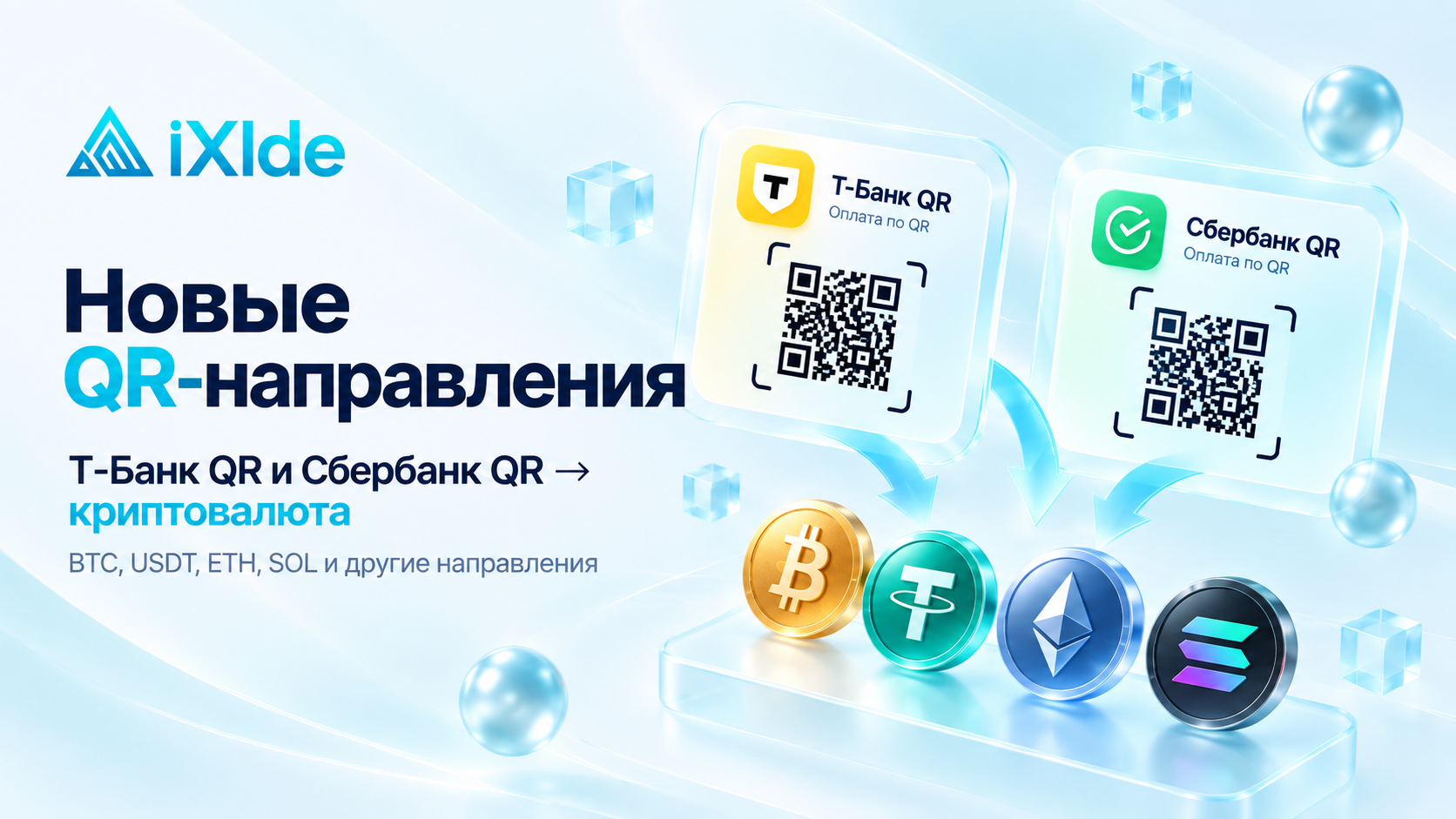
IXIDE has expanded the range of available exchange directions by introducing new payment options via T-Bank QR and Sberbank QR.
The update is designed to give users more ways to exchange rubles for digital assets while also simplifying the payment process through banking applications.
New Exchange Directions
IXIDE has introduced dedicated exchange directions:
T-Bank QR → Crypto
Sberbank QR → Crypto
These new directions cover both the most popular cryptocurrencies and a number of assets that are less commonly available through standard exchange services.
At present, the following exchange directions are available:
Bitcoin (BTC);
Tether USDT TRC20;
Tether USDT ERC20;
Tether USDT BEP20;
Ethereum (ETH);
TRON (TRX);
Litecoin (LTC);
Solana (SOL);
Dogecoin (DOGE);
USD Coin (USDC);
Binance Coin (BNB);
DAI;
Monero (XMR);
Polygon (POL);
Avalanche (AVAX);
Bitcoin Cash (BCH);
Dash (DASH);
GRAM.
This means users can choose not only major cryptocurrencies such as Bitcoin, Ethereum, and USDT, but also a range of less common digital assets.
How QR-Based Exchange Directions Work
When selecting a corresponding exchange direction, the user creates an exchange order and receives access to a payment form containing a QR code.
The user then opens their banking application, scans the QR code, verifies the payment details, and completes the payment according to the parameters of the order.
This format reduces the number of manual steps because users do not need to enter banking details themselves.
Instead of copying a card number, phone number, or other payment information, the user works directly with the QR code generated for the specific order.
T-Bank QR
Dedicated exchange directions are available for T-Bank users who want to exchange rubles for digital assets.
Examples include:
T-Bank QR → Bitcoin
T-Bank QR → USDT TRC20
T-Bank QR → Ethereum
T-Bank QR → Solana
T-Bank QR → Monero
and other supported cryptocurrencies.
The user selects the required asset and blockchain network in advance, creates an exchange order, and then completes the payment through the banking application.
Sberbank QR
A similar mechanism is available for exchange directions using Sberbank QR.
Available options include:
Sberbank QR → Bitcoin
Sberbank QR → USDT
Sberbank QR → Ethereum
Sberbank QR → Litecoin
Sberbank QR → Avalanche
Sberbank QR → Bitcoin Cash
and other exchange directions.
Dedicated QR directions allow users to select in advance which cryptocurrency they want to receive as a result of the exchange.
Support for Multiple USDT Networks
Special attention has been given to Tether USDT.
IXIDE supports exchange directions using several networks:
USDT TRC20;
USDT ERC20;
USDT BEP20.
When creating an order, users should carefully verify the selected network and make sure that the receiving wallet or service supports that exact standard.
Although the asset is called USDT in each case, transfers on the TRON, Ethereum, and BNB Smart Chain networks are technically separate blockchain transactions.
Choosing the correct network is therefore essential for successfully receiving funds.
Expansion of Less Common Exchange Directions
One of the goals of this update was to increase the number of less common exchange directions.
In addition to Bitcoin, Ethereum, and USDT, users now have direct access to assets such as:
Monero (XMR)
Avalanche (AVAX)
Polygon (POL)
DAI
Dash
Bitcoin Cash (BCH)
GRAM
and other cryptocurrencies.
This can be useful when a user needs a specific digital asset.
Without a direct exchange direction, the user might first have to purchase an intermediary cryptocurrency such as USDT and then perform an additional conversion separately.
A direct exchange direction can reduce the number of intermediary transactions.
Why IXIDE Is Expanding the Number of Exchange Directions
The cryptocurrency ecosystem continues to evolve, and users increasingly work with multiple blockchain networks and digital assets at the same time.
One user may need Bitcoin for long-term storage, another may need TRX for transactions on the TRON network, while someone else may require SOL for the Solana ecosystem or BNB for applications on BNB Smart Chain.
For this reason, the number of available exchange directions has practical importance.
IXIDE continues to expand the list of supported options so users can select the required asset directly when creating an exchange order.
Payment Requirements
When using QR-based exchange directions, users must strictly follow the parameters of the created order.
Users should:
pay the exact amount specified in the order;
use the QR code generated for the current order;
not reuse payment details from previous orders;
not change the payment amount manually;
carefully verify all payment details before confirming the transaction.
If the payment amount or other parameters do not match the order, additional verification may be required and processing may take longer.
Verifying the Receiving Address
Before creating an order, users should carefully verify the cryptocurrency wallet address.
Particular attention should be paid to the selected blockchain network.
Users are advised to check:
the cryptocurrency name;
the blockchain network;
the receiving address;
whether a Memo or Tag is required;
whether the receiving wallet or exchange supports the selected network.
Once a blockchain transaction has been confirmed, it generally cannot be cancelled or modified.
For this reason, the wallet address and selected network should always be checked before the order is submitted for processing.
Further Development of IXIDE Exchange Directions
The addition of T-Bank QR and Sberbank QR is part of IXIDE’s continued expansion of its exchange infrastructure.
We continue to develop both major and less common exchange directions so users can choose the most suitable option depending on the required cryptocurrency, network, and payment method.
The new exchange directions are already available in IXIDE.
Before creating an order, we recommend carefully reviewing the exchange parameters, checking the receiving network, wallet address, and payment amount.